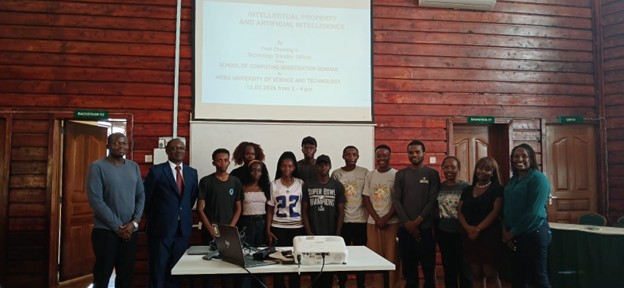
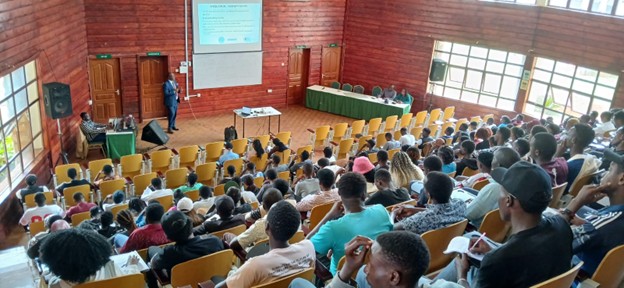
On Thursday, 12th March 2026, an Intellectual Property (IP) sensitization seminar was conducted for fourth-year students of the School of Computing and Informatics at Meru University of Science and Technology. The seminar was facilitated by Mr. Fred Otswong’o and Ms. Mary Asunta, marking the first intellectual property awareness session organized for students at the university. During the session, Mr. Fred Otswong’o delivered a comprehensive presentation on intellectual property, highlighting its importance in research, innovation, and commercialization. He explained the concepts of patents and copyrights, providing clear definitions to help students understand these commonly misunderstood terms. In simple terms, he described a patent as “an open letter granted by the government that gives an inventor the exclusive right to produce and sell their invention.” To further simplify the concept of copyrights, he used the example of song production to illustrate how creative works are protected.
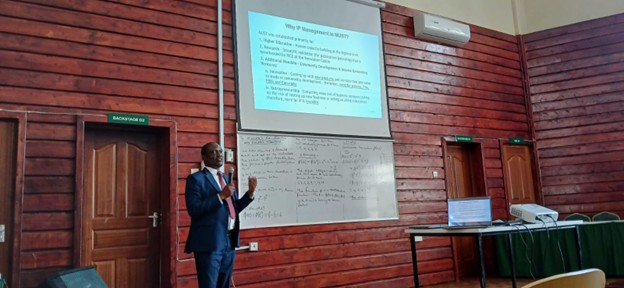
Mr. Otswong’o also emphasized the university’s core mandates: research and higher education, alongside an emerging mandate—innovation. He explained that innovation involves developing new products and services that add value to trade and contribute to community development. This, he noted, creates the need to protect innovations through patents, trademarks (TMs), plant breeders’ rights (PBRs), and copyrights.
The seminar also introduced students to the Technology Transfer Office (TTO), which is hosted within the university. The office plays a key role in supporting innovation through several functions, including intellectual property management—identifying, capturing, and protecting inventions developed by faculty and students through patents, copyrights, industrial designs, and trademarks. The TTO also conducts patentability searches and freedom-to-operate studies to ensure that new inventions do not infringe on existing intellectual property rights. In addition, it assists innovators in the commercialization of intellectual property by supporting marketing efforts and facilitating licensing negotiations.
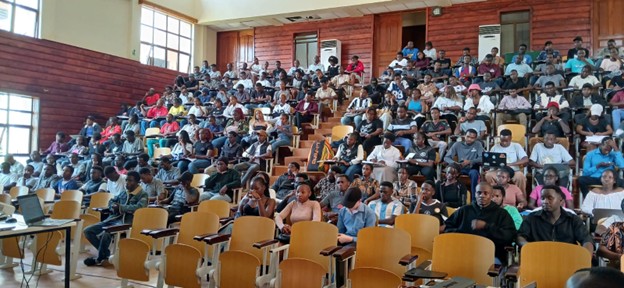
Mr. Otswong’o further outlined the eight key steps involved in commercializing an invention and explained the intellectual property systems available in Kenya, noting that there are seven major forms of IP protection.
The occasion also underscored the important nexus between academia and industry. Ms. Mary Asunta, Lecturer in Information Technology, whose presence and support demonstrated the university’s commitment to empowering students with future-ready skills, encouraged students to embrace innovation and entrepreneurship. She emphasized the importance of self-employment and urged students to consider creating their own opportunities through innovation rather than relying solely on the traditional search for employment after graduation.
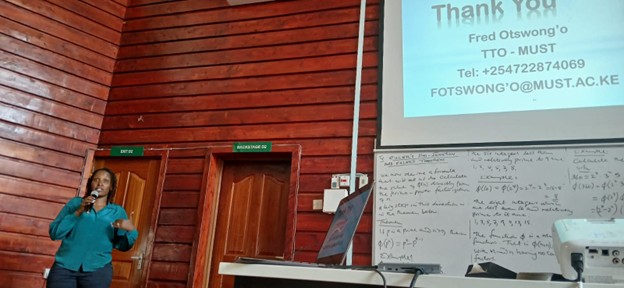
During the interactive question-and-answer session, students were encouraged to apply the concepts discussed. For example, a question was posed to James: “Looking at your innovated phone, what aspect would you patent?” Similarly, Faith was asked: “Using the same phone example, what part would you copyright?”
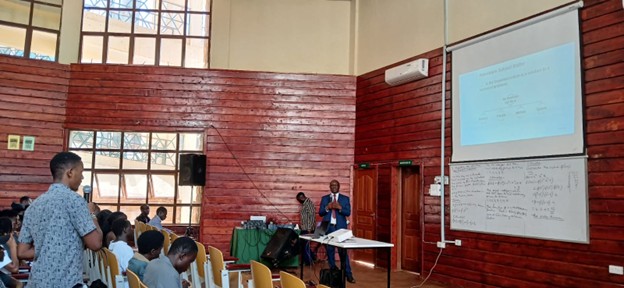
In his closing remarks, Mr. Otswong’o invited students to engage with the Research, Innovation, Commercialization, and Extension (RICE) Division by presenting their ideas and innovations for support and development. He explained that selected innovations can be incubated for up to three years. He also highlighted the university’s innovation policy, which allocates 90% ownership of innovations to the student inventor and 10% to the university.
The seminar provided valuable insights into intellectual property and encouraged students to protect and commercialize their ideas, reinforcing the university’s commitment to fostering innovation and entrepreneurship among its students.